Over the last four decades, I’ve walked hundreds of properties at dusk.
Fairfax.
Arlington.
Bethesda.
Rockville.
Annapolis.
McLean.
Potomac.
Columbia.
And there’s always a moment that tells me everything I need to know.
The homeowner flips the switch.
The lights come on.
And one of two things happens.
Either they smile and say, “That’s exactly what we wanted.”
Or they squint and say, “It just feels… off.”
Outdoor lighting is one of the most misunderstood investments a homeowner can make.
People think it’s about brightness.
It’s not.
It’s about placement.
The right fixture in the wrong spot creates glare. The wrong beam angle washes out texture. Too much light kills ambiance. Too little light creates shadows where safety should exist.
After 42 years designing and installing lighting systems across the DMV, I can tell you this clearly:
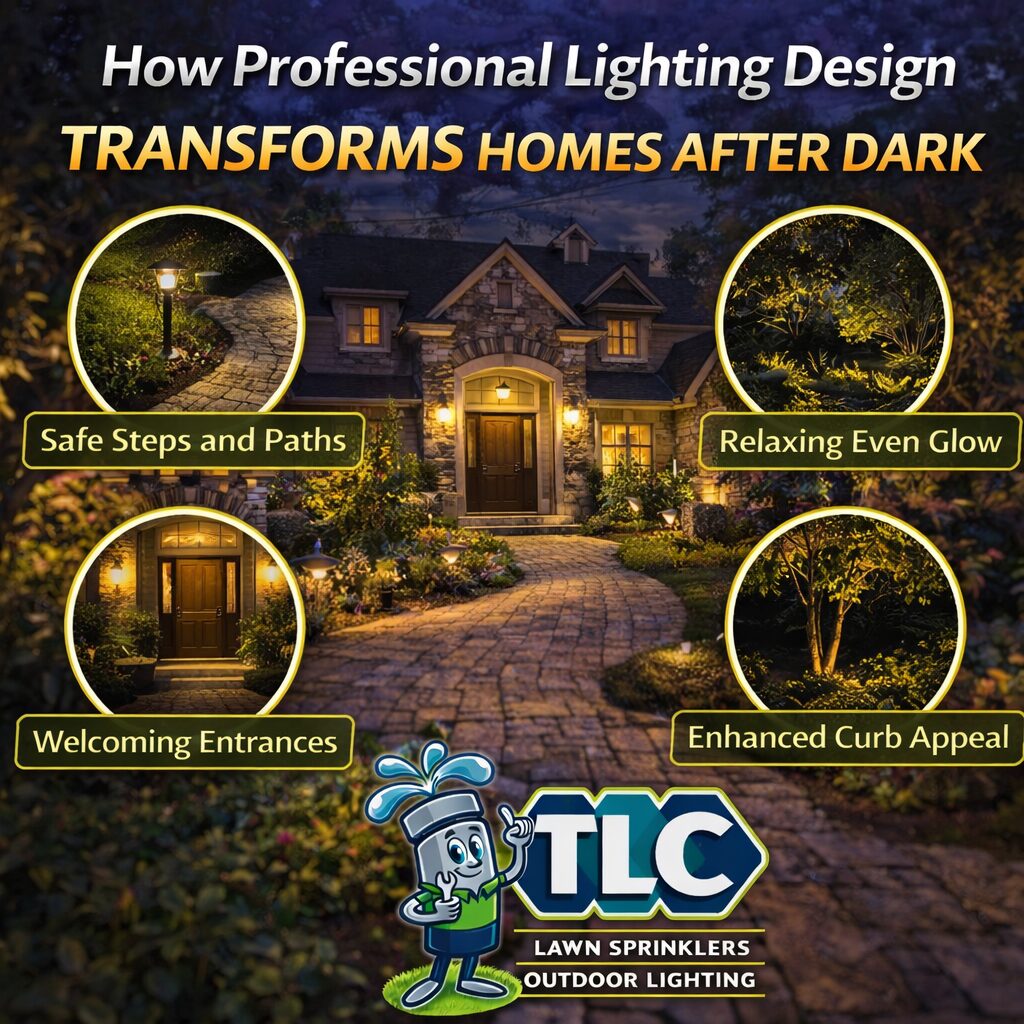
The best outdoor lighting design balances two things — safety and aesthetics — without sacrificing either.
And that balance always starts with placement.
Let me show you what that really means.
The First Mistake: Lighting for Brightness Instead of Purpose
When I arrive at a home where lighting “doesn’t feel right,” the most common issue is over-lighting.
Homeowners often think:
“If I add more fixtures, it’ll look better.”
But outdoor lighting is not a parking lot.
It’s architecture. It’s landscape. It’s mood.
In a Bethesda home we worked on recently, the homeowner had installed high-output flood lights along the entire back wall.
Yes — it was bright.
But it flattened the house.
It erased shadows.
It eliminated depth.
Instead of elegance, it felt commercial.
We removed half the fixtures, repositioned the others, adjusted beam angles, and dropped color temperature to 2700K.
The house didn’t get brighter.
It got better.
Safety First: Where Lighting Must Exist
Before aesthetics, we always address safety.
Proper safety lighting placement includes:
- Walkways and paths
• Steps and elevation changes
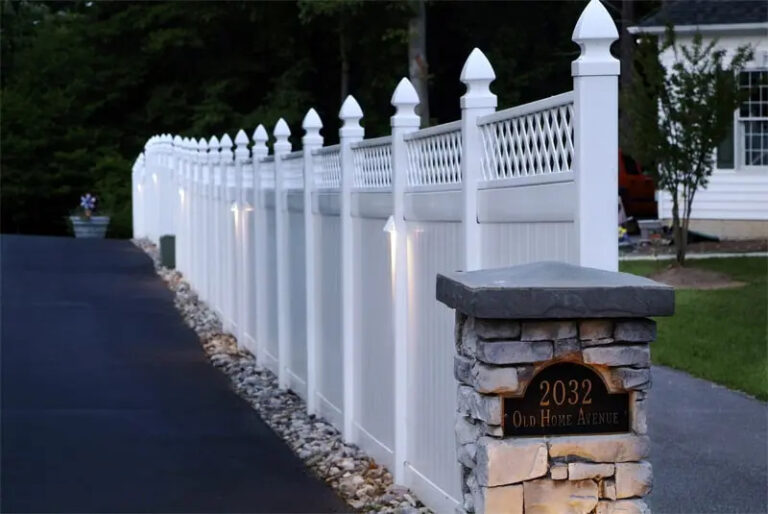
• Driveway edges
• Entry doors
• Transitions from light to dark areas
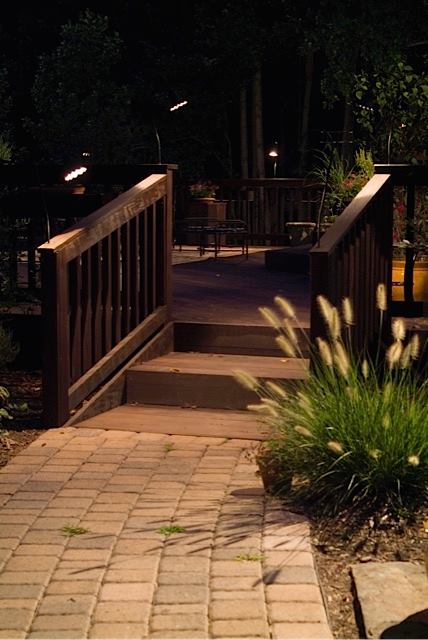
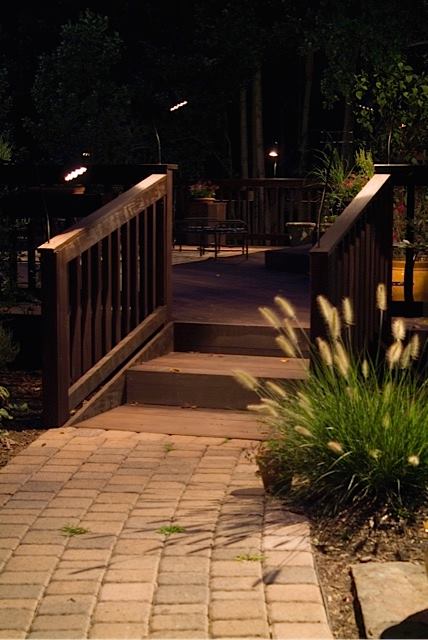
In the DMV, especially in older neighborhoods with uneven hardscapes, step lighting is critical.
I’ve seen more near-misses on unlit stone steps than I care to count.
But here’s the nuance.
Safety lighting should illuminate the surface — not blind the eye.
That means:
- Shielded fixtures
• Downward-facing beams
• Even spacing
• No glare into eye level
A properly lit walkway should guide you without you noticing the fixture itself.
If you see the bulb, it’s probably placed wrong.
The Art of Shadow: Why Darkness Matters
Here’s something that surprises people.
Darkness is part of good lighting design.
In McLean, we worked on a property where every tree had been individually lit with high-output uplights.
It looked impressive at first glance.
But there was no contrast.
When everything is bright, nothing stands out.
We reduced fixture count, narrowed beam spreads, and intentionally left certain areas darker.
The result?
The trees had dimension. The architecture had depth. The yard felt layered.
Good outdoor lighting is about contrast.
Light defines shape.
Shadow creates drama.
The Driveway Curve Problem
In Potomac and parts of Columbia, curved driveways are common.
Homeowners often line them with evenly spaced path lights.
The problem?
Curves require variable spacing.
Uniform spacing on a curve creates uneven visual rhythm.
We typically:
- Adjust spacing to follow arc geometry
• Use lower-lumen fixtures
• Stagger placement slightly to avoid runway effect
Driveway lighting should feel intentional — not like airport runway markers.
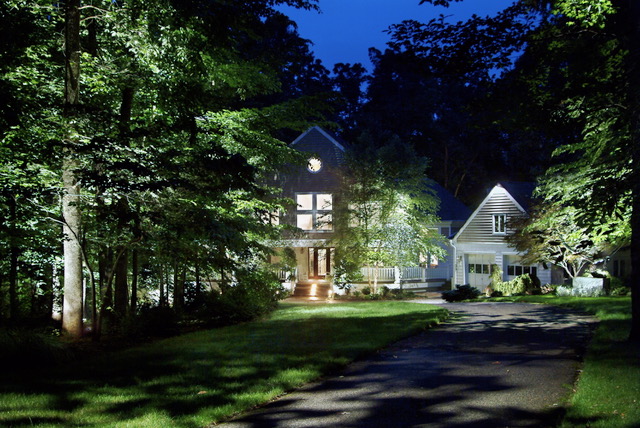
Lighting Mature Trees the Right Way
Maryland and Northern Virginia neighborhoods are known for mature trees.
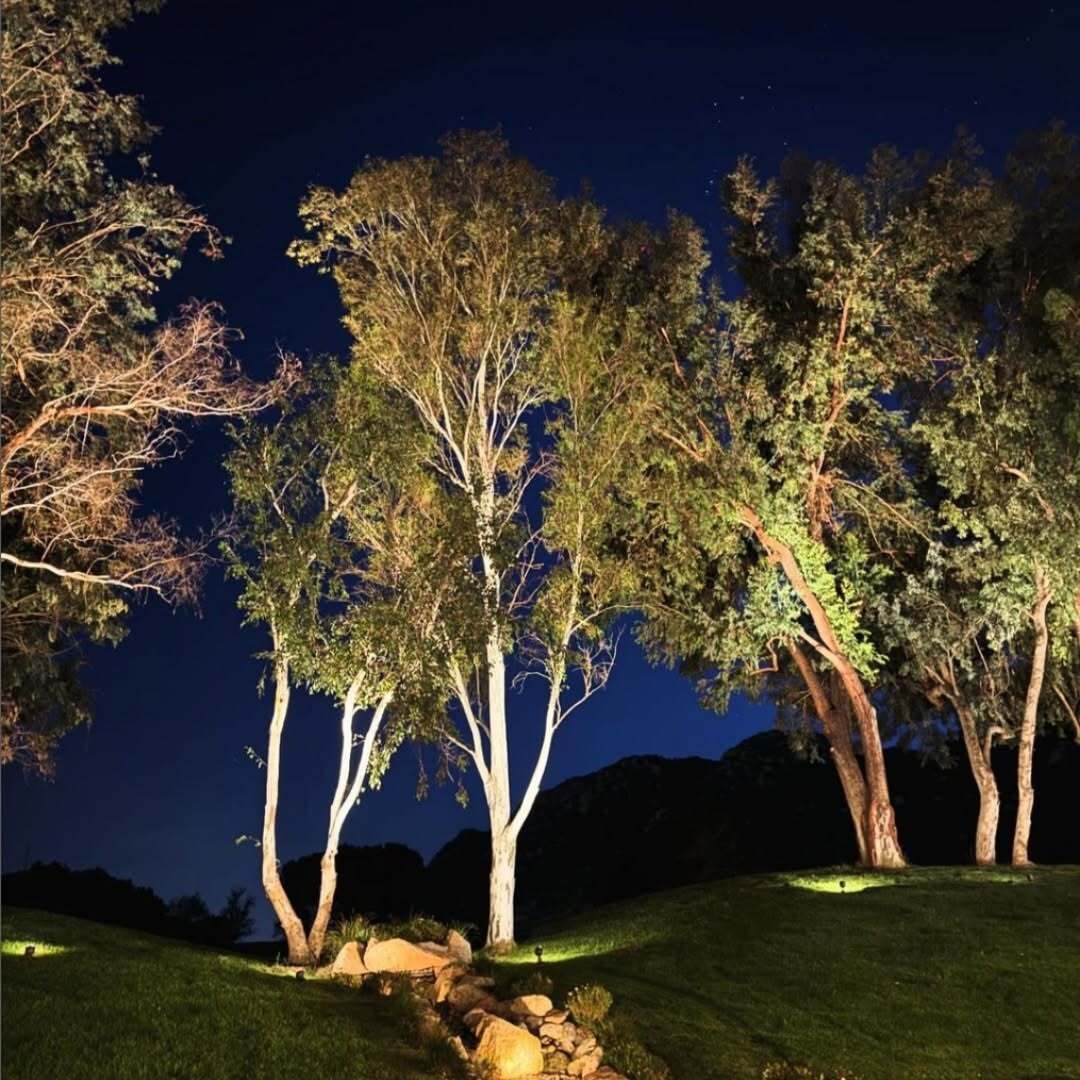
Uplighting these trees creates depth and value.
But placement is critical.
Common mistakes:
- Placing fixtures too close to trunk
• Using wide flood beams that wash out bark texture
• Overlighting small canopies
Correct placement often involves:
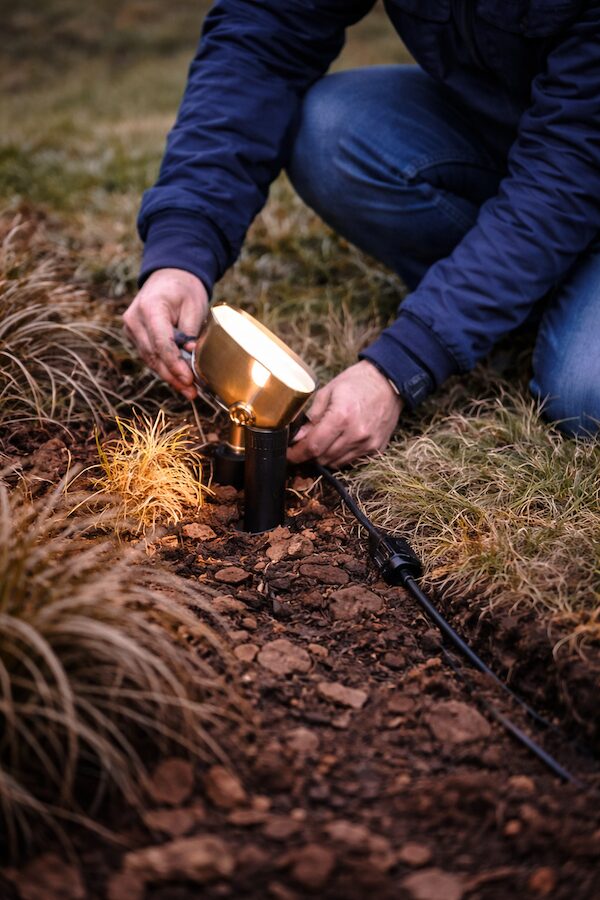
- Positioning fixture 12–36 inches from trunk (depending on tree size)
• Using narrow beam for vertical emphasis
• Balancing brightness to avoid overpowering nearby features
In Annapolis, we lit a single oak properly instead of three poorly.
The entire yard transformed.
One correctly placed fixture can outperform five misplaced ones.
Front Elevation: Architectural Placement Strategy
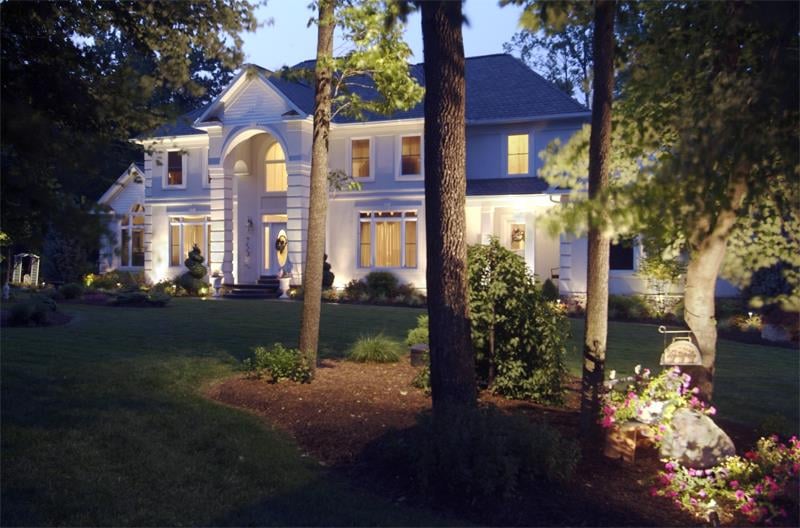
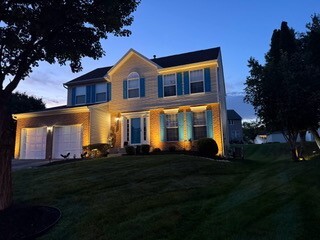
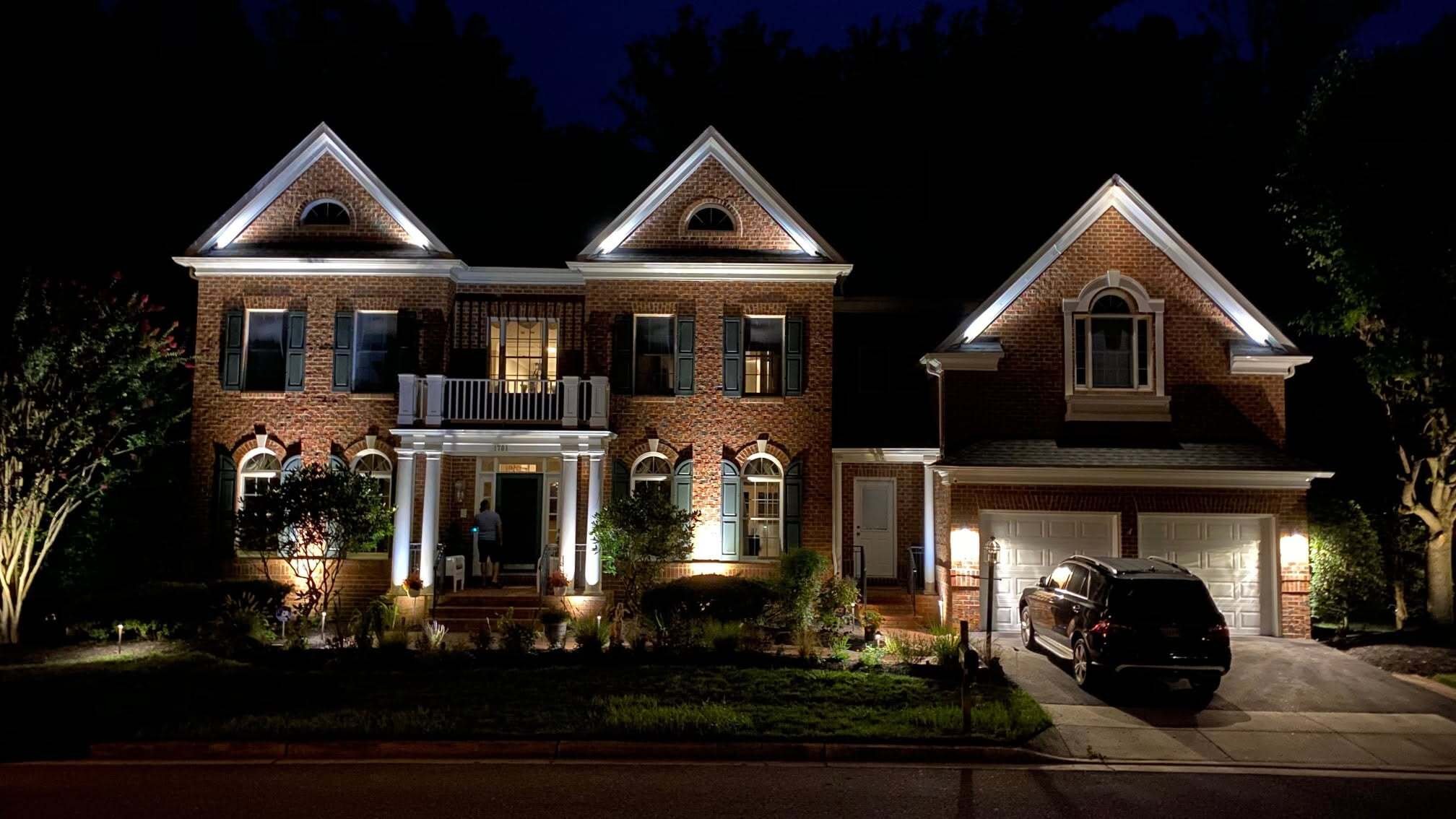
Your home’s facade tells a story at night.
Lighting should emphasize:
- Columns
• Stonework
• Brick texture
• Entry features
• Architectural lines
Avoid:
- Flat wall washing without dimension
• Glare near windows
• Uneven brightness across facade
A Bethesda homeowner once told me, “I want it to look expensive.”
That doesn’t come from brighter lights.
It comes from symmetry, balance, and intentional placement.
Backyard Lighting: Function Meets Atmosphere
Backyards serve multiple roles.
Dining.
Entertaining.
Relaxing.
Movement between spaces.
Backyard lighting must support all of that.
We divide backyard placement into layers:
Layer 1 – Functional
- Patio seating
• Grill areas
• Steps
Layer 2 – Transitional
- Pathways
• Gate entries
• Pool edges
Layer 3 – Aesthetic
- Tree uplighting
• Garden accents
• Water features
When layers work together, the yard feels like an extension of the home — not an afterthought.
The 12V vs 120V Placement Consideration
Most residential systems use low-voltage (12V) lighting.
Why?
- Safer
• Flexible placement
• Easier adjustments
• Lower energy consumption
Placement with 12V allows subtlety.
You can fine-tune brightness and beam angle.
120V systems often limit flexibility and increase glare risk.
Placement freedom equals design freedom.
Real DMV Case Study: Arlington Safety + Aesthetic Redesign
An Arlington homeowner called because their front walkway felt unsafe and their home looked flat at night.
Existing setup:
- Four flood lights near door
• No step lighting
• No tree lighting
We redesigned placement to include:
- Shielded path lights spaced evenly
• Two narrow-beam uplights on columns
• One canopy light for mature tree
• Warm 2700K LED temperature
Cost: ~$6,500
The homeowner later told me,
“It feels like a different house.”
Same house. Better placement.
Cost Considerations in the DMV
Lighting cost is driven more by fixture count and layout complexity than brightness.
Typical ranges:
Small front-yard system:
$3,000–$6,000
Mid-size property:
$6,000–$12,000
Larger estate properties:
$12,000–$25,000+
The biggest mistake I see is homeowners trying to reduce cost by eliminating design.
Design is what makes the investment worth it.
The Emotional Impact of Proper Lighting
Here’s what doesn’t show up in the invoice.
When outdoor lighting is placed correctly:
- You feel safer walking at night
• Guests linger longer outdoors
• The house feels more welcoming
• Curb appeal increases
• Pride of ownership grows
Lighting changes how you experience your home.
And experience matters.
The Bigger Lesson
The best outdoor lighting placement for safety and aesthetics is not about quantity.
It’s about intentional balance.
In the DMV, where homes have character and mature landscapes, thoughtful placement enhances architecture rather than overpowering it.
After 42 years serving Maryland, DC, and Northern Virginia homeowners, I’ve learned this clearly:
Good lighting disappears.
You don’t see fixtures.
You see the effect.
And when placement is correct, safety improves quietly, and aesthetics feel natural.
The Bottom Line
If you’re planning outdoor lighting in the DMV, focus on:
- Proper walkway illumination without glare
• Architectural emphasis through contrast
• Strategic tree uplighting
• Balanced driveway spacing
• Layered backyard design
• Warm color temperature
Lighting isn’t about brightness.
It’s about precision.
And when precision meets placement, the result isn’t just visibility.
It’s transformation.