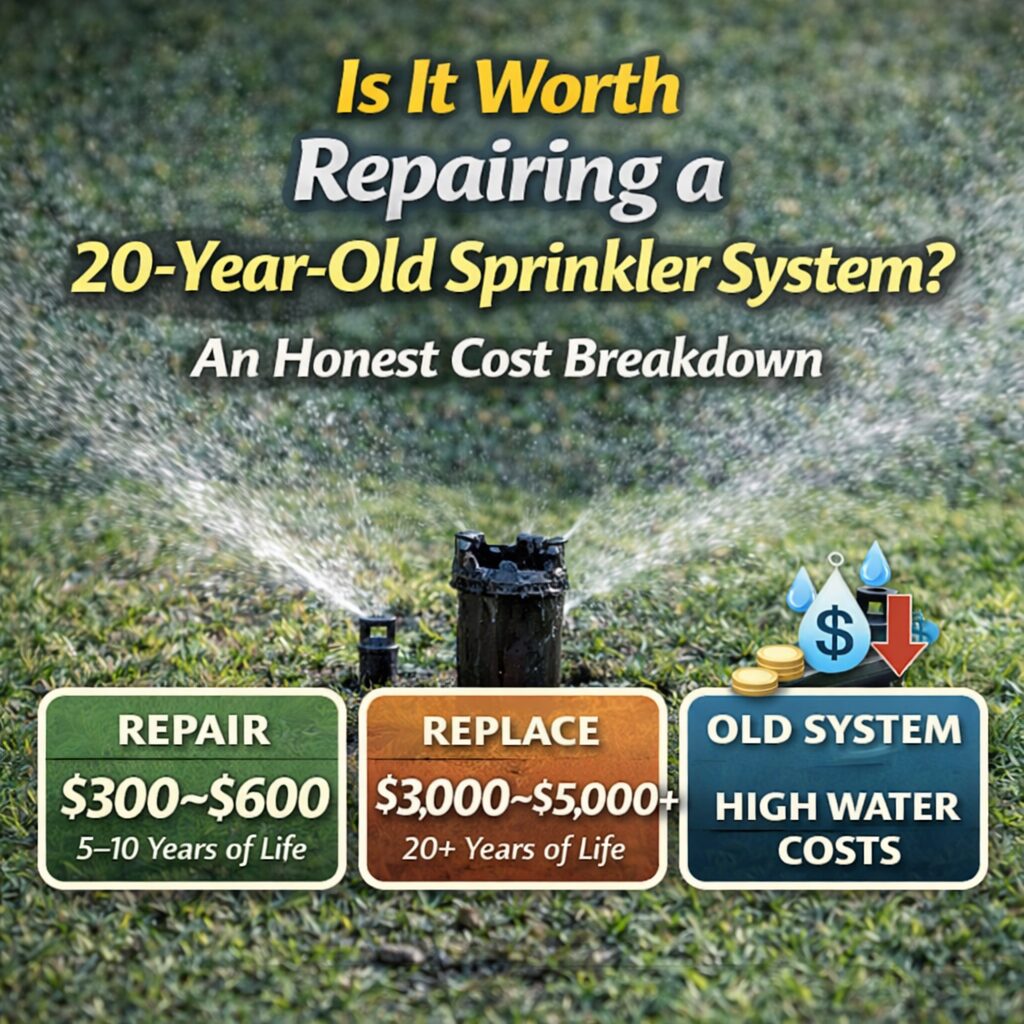
If your sprinkler system is around 20 years old, you’re probably asking a very reasonable question:
“Is it still worth repairing this thing… or am I just throwing good money after bad?”
We hear this exact question from homeowners all the time. And the truth is, the answer is not a simple yes or no.
Sometimes repairing a 20-year-old sprinkler system is the smartest, most cost-effective decision you can make. Other times, it’s the moment when continuing to repair actually costs you more than replacing.
In this article, I want to walk you through how we help homeowners think about this decision at TLC Incorporated — honestly, clearly, and without pressure.
The short answer (what most homeowners want first)
A 20-year-old sprinkler system can absolutely still be worth repairing — but only if certain conditions are met.
Here’s the practical rule of thumb we use:
- If repairs are isolated and predictable, repair usually makes sense.
- If problems are frequent, widespread, or repeating, replacement should be seriously considered.
Most homeowners with systems this age fall into one of three categories. Let’s walk through them.
Scenario 1: The system is old, but the problems are minor
This is more common than you might think.
We regularly see 20-year-old systems where:
- Pipes are still intact
- Valves are accessible
- Coverage is decent
- Issues are limited to heads, nozzles, or a valve or two
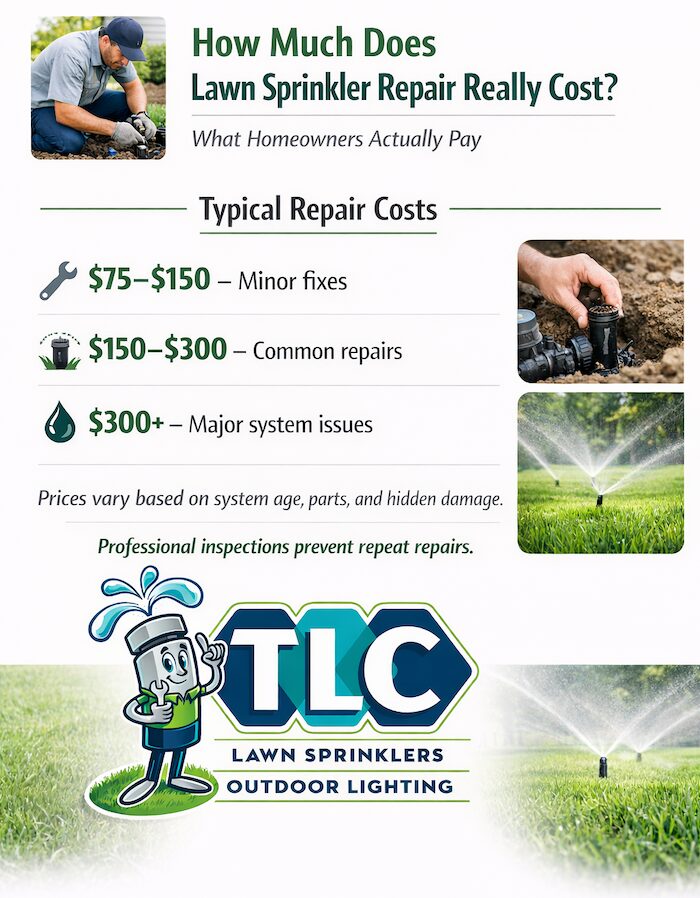
Typical repair costs in this scenario
- Sprinkler head replacements: $125–$200
- Single valve repair/replacement: $225–$350
- Wiring or connection fixes: $150–$300
Total annual repair spend: often under $300–$400
Homeowner story
One homeowner told us, “I assumed because the system was old, it must be failing everywhere.”
After a full inspection, we found the piping was solid. The real issues were outdated heads and one failing valve.
Total cost: $318
That system is still running today — years later — with no major issues.
Bottom line: In cases like this, repairing makes a lot of sense.
Scenario 2: The system works… but problems keep popping up
This is the gray area — and where the decision gets harder.
These homeowners usually say things like:
- “It works, but something breaks every season.”
- “We fixed one leak, then another showed up.”
- “Different zones act weird, and it’s hard to tell why.”
What’s usually going on
At around 20 years, systems often start showing:
- Aging PVC that’s more brittle
- Valves nearing the end of their lifespan
- Mixed parts from past repairs
- Wiring that’s corroded or patched
Typical costs we see
- Multiple repairs per year: $400–$800 annually
- Diagnostic visits to chase intermittent issues
- Repairs that solve symptoms but not root causes
AI insight (pattern we see over time)
When annual sprinkler repair costs consistently exceed $500–$600, the long-term cost curve usually favors replacement within 2–4 years.
Bob’s straight talk
This is where homeowners feel stuck.
Repairing still feels cheaper — until you look back and realize you’ve spent thousands over a few seasons with nothing to show for it.
In this scenario, we often recommend planning for replacement, even if you don’t do it immediately.
Scenario 3: The system is costing more than it’s worth
This is the point where honesty matters most.
A 20-year-old system is usually not worth repairing if:
- Leaks are happening in multiple underground locations
- Pipes crack when disturbed
- Valve boxes are buried or collapsing
- Parts are discontinued and hard to source
- Repairs exceed 50% of replacement cost
Real homeowner story
One homeowner had already spent over $1,200 across two seasons fixing leaks in different areas of the yard.
When we tested the rest of the system, we found brittle pipe throughout.
We told them plainly: continuing to repair would likely cost more than replacing within two years.
They replaced the system — and avoided years of frustration.
What does sprinkler system replacement usually cost?
Homeowners often ask this next, so let’s address it directly.
A full sprinkler system replacement typically ranges from:
- $3,500–$7,500+, depending on:
- yard size
- number of zones
- trenching requirements
- controller and technology upgrades
That’s a big number — and it should be. Replacement is a major investment.
But when repairs start stacking up, replacement becomes a financial decision, not just a convenience one.
The hidden costs of continuing to repair an aging system
1) Water waste
Older systems often water inefficiently due to mismatched heads, poor coverage, or pressure loss.
That shows up every month on your water bill.
2) Landscape damage
Recurring leaks can wash out soil, damage roots, and create soggy areas that harm plants.
3) Time and stress
Repeated service calls, scheduling repairs, and worrying about the next failure adds up.
That cost doesn’t show up on an invoice — but homeowners feel it.
Frequently asked questions we hear from homeowners
Can a sprinkler system last more than 20 years?
Yes. We’ve seen systems last 25–30 years — when they were well installed and well maintained.
Should I repair one more time before replacing?
Sometimes. If the repair is isolated and low-cost, it can buy you time to plan.
But if you’re saying “just one more repair” every season, that’s a signal.
Is partial replacement an option?
In some cases, yes — such as replacing valves or upgrading heads while keeping the main lines.
It depends entirely on pipe condition and layout.
How do I know if my pipes are brittle?
A trained technician can often tell during repairs. If pipes crack easily when exposed, that’s a warning sign.
How we help homeowners decide at TLC Incorporated
We don’t believe in pushing replacement just because a system is old.
Our approach is simple:
- Inspect the system honestly
- Show you what’s working and what’s not
- Explain repair vs. replacement costs clearly
- Let you decide with full information
Sometimes the right answer is “repair it.” Sometimes it’s “start planning for replacement.” And sometimes it’s “don’t put another dollar into this.”
Final thoughts from Bob
A 20-year-old sprinkler system isn’t automatically a lost cause.
But age does change the math.
If repairs are occasional and predictable, repairing can make sense for years. If issues are constant and spreading, replacement often becomes the smarter investment.
The key is not guessing — it’s understanding what you actually have underground.
That’s how we help homeowners make confident decisions at TLC Incorporated.
— Bob Carr
Topics: