
Ask ten irrigation contractors which brand they prefer, and you'll get ten confident answers, about half of them contradicting each other.
As the leading lawn sprinkler company servicing Maryland for more than 40+ years, TLC Incorporated has helped thousands of homeowners get the most from their irrigation — designing, installing, upgrading, and maintaining both Rain Bird and Hunter systems.
Rain Bird and Hunter have dominated residential and light commercial irrigation for decades, and the rivalry has taken on a Ford-versus-Chevy quality. The truth is less dramatic. Both companies make good equipment and neither wins across the board. What matters is which specific component you're buying, where you're buying it, and whether you're installing it yourself.
Here's a category-by-category breakdown based on how these products behave in the field.
The Short Answer
If you want to stop reading here: Hunter makes the better rotor for most residential lawns and the better rotary nozzle by a comfortable margin. Rain Bird makes the better spray body and is far easier to find at retail. Controllers are close, with Hunter's app experience ahead and Rain Bird's retrofit path cheaper. Most experienced installers mix the two brands freely, because everything threads together anyway.
Hunter PGP Ultra vs. Rain Bird 5000: Which Rotor Is Better?
This is the main matchup, and the one place with fairly clear consensus among pros.
The Hunter PGP Ultra is the most widely installed gear-drive rotor in the country, and it earns that. Arc adjustment areis done with a flathead screwdriver from the top of the head, no special key required, which sounds trivial until you're adjusting forty heads on your hands and knees. The nozzle rack, twelve nozzles including four low-angle options, stores inside the top of the unit. Parts are everywhere.
The Rain Bird 5000 series is a good rotor with one real technical advantage: Rain Curtain nozzle technology produces noticeably better close-in watering. Standard rotors tend to leave a dry donut around the head itself, and Rain Bird's larger droplet distribution addresses that better. On tight turf areas or windy sites, that matters.
Where the 5000 loses ground is adjustment. You'll want the Rain Bird key, and setting the arc is fussier than the PGP's. The 5000 also sees more reported stem retraction issues in sandy soil, though pressure-regulating (PRS) versions of both brands mitigate much of that.
Edge: Hunter, primarily on serviceability.
Spray Heads and Nozzles
The Rain Bird 1800 series spray body, particularly the 1804 SAM-PRS, is close to an industry default. The co-molded wiper seal holds up well, the built-in check valve stops low-head drainage, and the pressure-regulating stem keeps misting under control. Hunter's Pro-Spray PROS-04 is a competent equivalent, but the Rain Bird body is the one most supply houses stock in volume.
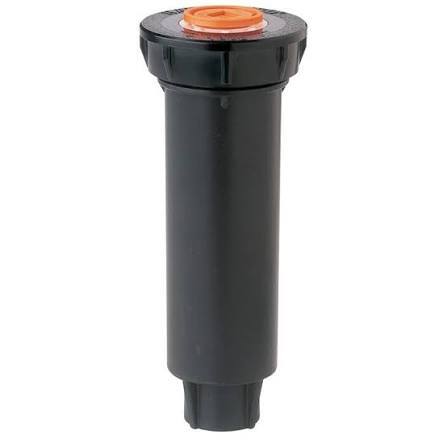 Rain Bird 1804 SAM-PRS
Nozzles are a different story. The Hunter MP Rotator is the best rotary nozzle on the market and it isn't close. It delivers low precipitation rates with excellent uniformity, handles slopes well, and has a long enough track record that its failure modes are well understood. Rain Bird's R-VAN adjusts by hand without tools, which is nice, but hasn't matched the MP Rotator's durability reputation.
Edge: Rain Bird on bodies, Hunter on nozzles. Fortunately, you can run MP Rotators on Rain Bird bodies, and plenty of people do.
Valves
Hunter's PGV series and Rain Bird's DV/DVF residential valves are both reliable and roughly interchangeable, with PGVs often slightly cheaper. At commercial grade, Rain Bird's PEB and PESB (the scrubber version, worth it on dirty water) have a strong reputation; Hunter's ICV line is the answer to it.
For a typical residential system, this is a coin flip. Buy whatever your local supplier stocks, because you want replacement diaphragms available locally in five years.
Edge: Tie.
Controllers and Smart Watering
Hunter's Hydrawise platform runs on the X2 with WAND module, the Pro-HC, and the HPC. It's been in development for roughly a decade, and it shows. Predictive Watering adjusts schedules using forecast temperature, rainfall probability, wind, and humidity rather than just reacting to yesterday's rain, and an optional flow meter will alert you to a broken pipe or stuck head. The app is the better of the two.
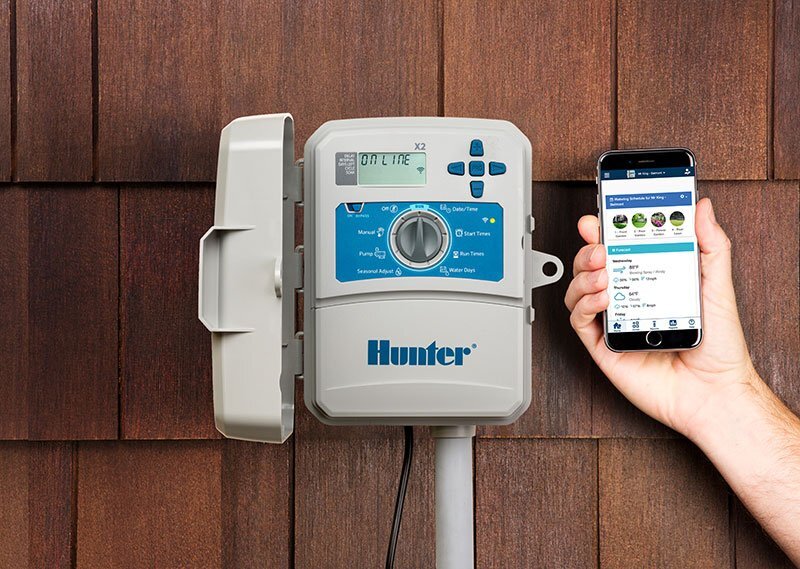 X2 with WAND Smart Irrigation Controller
Rain Bird's residential line centers on the ESP-TM2 for straightforward jobs and the ESP-ME3 for larger systems, with the LNK2 Wi-Fi module snapping into the faceplate to add smart control. Paired with a WR2 rain sensor, these earn EPA WaterSense certification.
Rain Bird's advantage is the retrofit path: if you already own an ESP-TM2 or compatible ESP-Me, you add Wi-Fi for the price of a module instead of a whole new controller. One caveat for home automation users, though. Rain Bird's local integration runs through the LNK/LNK2 module, and migrating to the newer cloud app can break it.
Edge: Hunter on software, Rain Bird on upgrade cost.
Availability, Price, and Support
Rain Bird is much easier to buy. Home Depot and Lowe's carry a broad selection including full DIY kits. Hunter is primarily a professional-channel brand sold through distributors like SiteOne and Ewing, with thinner big-box presence. For DIY, that's a real advantage: when a head cracks on a Saturday afternoon, a fifteen-minute drive to a hardware store beats waiting for a distributor to open Monday.
Pricing is comparable at equivalent grades. Warranty terms vary by model, so check the specific product; Hunter's smart controllers carry a two-year warranty, and both brands offer longer coverage on heads.
The Verdict: Rain Bird vs. Hunter
Choose Hunter if you're hiring a contractor, you have significant turf needing rotors, or you want the best smart controller experience. PGP Ultra plus Hydrawise is an excellent combination.
Choose Rain Bird if you're installing it yourself, you value walk-in parts availability, or you're upgrading an existing Rain Bird system where the LNK2 module saves a full controller replacement.
Or mix them, like most pros do. Sprinkler components use standard 1/2-inch NPT threads, so Hunter rotors, Rain Bird spray bodies, MP Rotator nozzles, and whichever controller you prefer all coexist without complaint. Brand loyalty in irrigation is mostly a supplier relationship, not an engineering conclusion.
Planning a new lawn sprinkler system or upgrading your existing one? TLC offers free lawn sprinkler system estimates to help you understand your options and determine the right system for your property. Our irrigation specialists can assess your yard and recommend a solution designed to provide efficient, reliable watering.
Frequently Asked Questions
Can I mix Rain Bird and Hunter parts in the same system? Yes. Both brands use standard 1/2-inch NPT threading, and all 24VAC solenoid valves work with any standard controller regardless of brand. Mixing is common practice. The one rule: don't mix different head types or brands within the same zone, because differing precipitation rates will leave you with dry spots and soggy spots on the same run time.
Are Hunter MP Rotators compatible with Rain Bird spray bodies? Yes, and it's a popular combination. MP Rotators thread onto any standard spray body, including Rain Bird 1800 series. Just make sure the body has pressure regulation, since MP Rotators are designed to operate around 40 PSI.
Which brand is better for a DIY installation? Rain Bird, mainly on availability. It's stocked at major home improvement retailers along with design tools and starter kits. Hunter products are excellent, but you'll typically be ordering online or visiting a distributor.
Which brand lasts longer? Neither has a decisive advantage. Installation quality, water quality, and pressure regulation affect lifespan far more than brand. Heads on an unregulated high-pressure system fail early regardless of the logo.
Can I replace a Hunter head with a Rain Bird head? Yes, physically. But if the rest of the zone is Hunter, match the replacement to what's there. A single mismatched head throws off the zone's distribution uniformity.
