
If you have an irrigation system, you may not realize it needs to be winterized before the first hard freeze. Without proper winterization, water left in the pipes can freeze, expand, and cause costly damage that may not become apparent until spring.
Outdoor lighting isn't like that. There's nothing to drain, and you shouldn't shut it down for the season. But winter is still the hardest stretch of the year on a lighting system, and a couple of hours in late fall will save you from dark fixtures in January, when the ground is frozen and nobody wants to dig.
TLC has been designing and installing outdoor lighting across Maryland for over 40 years, from a few path lights to full-property systems with tree uplights and deck lighting. If you’re unsure how to prepare your outdoor lighting system for winter, here’s what we would do.
Checklist for Winterizing Before the First Hard Freeze
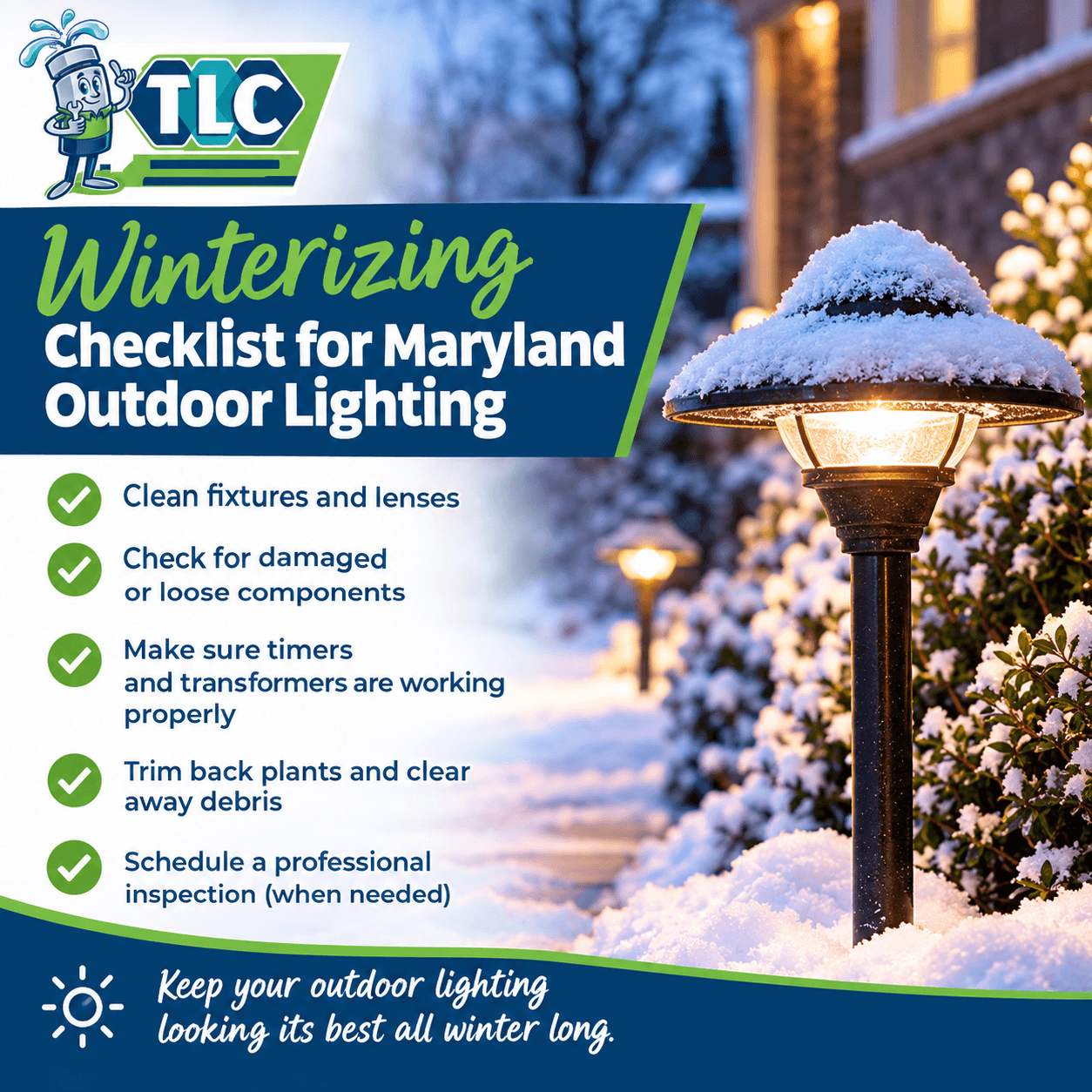
1. Clean the lenses. A summer of pollen, rain splash and lawn clippings leaves a film on the glass that noticeably dims output. Wipe each lens with a damp cloth. If you have hard water spots, a little white vinegar clears them. This is the cheapest brightness upgrade you'll ever make.
2. Dig fixtures out of the mulch. Every fall we find path lights and uplights buried by a season of mulch, leaf litter and grass clippings. Buried fixtures overheat, hold moisture against the housing, and light the mulch instead of the tree. Clear a few inches around each one and make sure it sits at the height it was installed at.
3. Reset the fixtures that have sunk or shifted. Maryland's clay soil and freeze-thaw cycles push fixtures out of position over time. Straighten anything leaning, and press stakes back down firmly before the ground freezes. A fixture that's loose going into winter will be looser coming out.
4. Re-aim after the leaves come down. This is the step almost everyone skips. Your lighting was aimed in summer with a full canopy. Once Maryland's oaks and maples drop, uplights that were hitting leaves now shoot past the tree into your neighbor's bedroom window. Walk the property after dark in November and re-aim anything that's overshooting.
5. Check your connections. Look at every wire connection you can reach. They should be waterproof, gel-filled or silicone-filled connectors, not twist caps or electrical tape. Corroded or wet connections are the single most common cause of lights going out mid-winter, and they're far easier to fix in November than in February.
6. Inspect the transformer and its outlet. Open the transformer and look for corrosion, insect nests or water intrusion. Make sure the door seals and the knockouts are sealed. Then check that the outlet it plugs into is GFCI-protected and has a weatherproof in-use cover. Test the GFCI by pressing the test and reset buttons.
7. Make sure water drains away from the transformer. Ice builds where water sits. If the ground below the transformer stays soggy, that's a drainage issue worth fixing before winter, not just for the lighting.
8. Replace failing lamps now. If a fixture is flickering, dimming or already out, deal with it while the ground is workable and the weather is tolerable. Diagnosing a wire fault in frozen ground is a much bigger job.
9. Reset your timer for winter. This matters more in Maryland than people expect. At the winter solstice, it's dark here by about 4:45 in the afternoon and not light again until past 7 in the morning, roughly five hours more darkness than in June. If your controller runs on a fixed clock schedule, you're leaving the front of your house dark during the exact hours people are coming home from work. If it's astronomical or weather-based, confirm it's actually tracking sunset and adjust the off time to suit your household.
10. Mark the fixtures near driveways and walks. Snow removal is the leading cause of physical damage we see. Plow blades, snow blowers and shovels destroy path lights that nobody could see under eight inches of snow. Push a marker stake beside each fixture along the driveway and walkways, and tell whoever plows for you where they are.
11. Keep rock salt off your fixtures. De-icing salt is hard on metal finishes and on the plants around them. When you're salting steps and walks, be mindful of what's within splash range, and rinse fixtures in the spring. If you're near the Bay, your fixtures are already dealing with salt air year-round, which is why solid brass and copper hold up so much better than painted aluminum here.
12. Check tree-mounted fixtures before storm season. Anything mounted in a tree needs a look before the first ice storm: is the hardware still secure, and has the tree grown into the strap or clamp? A limb that's been quietly girdled all summer is a limb that comes down under ice.
13. Coordinate with your holiday lighting. If holiday lights are going on the same exterior circuits, make sure you're not overloading them, and decide how the two systems will share timers. It's also worth having your landscape lighting installer and holiday lighting crew aware of each other, so nobody stakes a display through a buried lighting wire.
14. Coordinate with irrigation winterization. If both systems are in the same yard, schedule them together where you can. Crews working around valve boxes and heads are working right where your lighting wire runs.
Through the Winter
After any significant snow, clear snow off fixture lenses and don't pile shoveled snow on top of them. Snow blocks light and, more importantly, the weight of a compacted pile can crack a lens or bend a stake.
After ice storms and heavy wind, walk the property and look for fixtures knocked out of aim by falling limbs, and for exposed wire where runoff has washed soil away.
If a whole zone goes dark, check the transformer and the GFCI outlet first. A tripped GFCI after a wet spell is the most common explanation, and resetting it is free.
What Not to Do
Don't shut the system off for the season. We hear this one a lot, usually as an energy-saving idea. It's backwards. Winter is when Maryland is dark for fifteen hours a day, when ice makes steps and walkways genuinely hazardous, and when an unlit house is most obviously unoccupied. Modern LED systems cost very little to run. Leave them on, and let the timer do the work.
Don't pressure wash your fixtures. It forces water past seals that were designed to shed rain, not to take a direct jet.
Don't ignore one dark fixture. In a low-voltage system, a single failure is often the first sign of a wiring or connection problem that will spread.
Struggling to Complete the Checklist? Call TLC
Most of the list above is straightforward. It's also thirteen items, in the cold, after dark, with a ladder involved for anything mounted in a tree.
TLC services systems we installed as well as ones we didn't. A seasonal maintenance visit covers the whole checklist in one trip: cleaning lenses, clearing mulch, resetting and re-aiming fixtures after leaf drop, checking every connection, inspecting the transformer and GFCI, replacing failed lamps, and adjusting your timer for Maryland's winter sunset.
If you also have an irrigation system with us, we can schedule your lighting visit alongside your winterization so it's one appointment instead of two.
Whatever you decide, do the walkthrough before the ground freezes. A loose connection found in November is a ten-minute fix. The same connection found in February is a dig through frozen clay.

Frequently Asked Questions
Do outdoor lights need to be winterized like a sprinkler system?
No. There's no water in the system, so there's nothing to blow out or drain. Winterizing lighting means cleaning, inspecting, re-aiming and adjusting the schedule, not shutting anything down.
Can LED landscape lights handle Maryland cold?
Yes. LEDs actually perform well in cold weather and often run more efficiently than in summer heat. Cold is hard on connections, seals and fixture finishes, not on the light source itself.
Will snow damage my fixtures?
Snow itself won't. Snow removal will. Plows, snow blowers and shovels cause most of the winter damage we see, which is why marking fixtures along driveways and walks is worth the ten minutes it takes.
Is it safe to shovel or blow snow around landscape lighting?
Yes, as long as you know where the fixtures are. Don't pile snow on top of them, and don't let a snow blower chute fire directly into one.
Will de-icing salt hurt my lights?
It can corrode finishes over time, especially on painted and aluminum fixtures, and it's hard on nearby plants. Keep salt out of direct splash range where you can, and rinse fixtures in spring.
My lights come on too late in winter. How do I fix that?
Adjust your timer. A fixed-clock timer needs to be reset several times a year as sunset moves. A photocell or an astronomical timer follows sunset automatically, and a smart controller lets you change the schedule from your phone — a worthwhile upgrade if you're resetting a timer four times a year.
A whole section of my lights went out after a storm. What now?
Start with the GFCI outlet the transformer is plugged into and reset it if it's tripped. If that doesn't restore power, or the zone comes back and fails again, it's usually a connection or wire fault that needs a professional look.
Can someone just do this for me?
Yes. A seasonal maintenance visit covers the cleaning, inspection, re-aiming, connection checks and timer adjustment in one trip, and it's the same visit where small problems get caught before they become winter repairs.
