
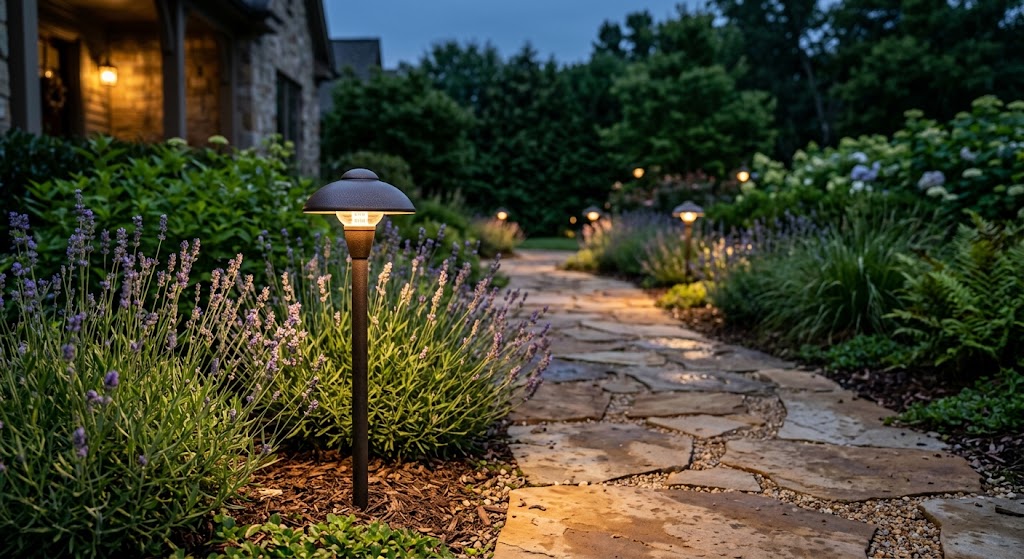
For most homes, low-voltage lighting is the better choice for landscape lighting. It's safer, more energy-efficient, and easier to adjust as your yard changes. Line-voltage lighting still has its place, though, especially when you need a lot of light over a large area.
TLC designs and installs custom outdoor lighting that makes your home safer, more inviting, and beautiful after dark. From path and tree lighting to smart controls you can run from your phone, we build energy-efficient LED systems around your yard, your goals, and your budget.
If you're planning outdoor lighting for your home, one of your first decisions is which system to use. Here's how each one works, how they compare, and how to choose the right fit for your property.
What Is Line-Voltage Lighting?
Line-voltage lighting runs on the same 120-volt power as the outlets and fixtures inside your home. The fixtures connect directly to your electrical system, with no transformer in between.
Because it carries full household current, line-voltage wiring has to meet strict electrical code. That usually means running wire through conduit, burying it deeper (often 18 inches or more), and using weatherproof junction boxes. In most cases, a licensed electrician needs to do the work, and a permit may be required.
Line-voltage is common for security floodlights, porch and garage lights, and lights mounted on the side of a house.
What Is Low-Voltage Lighting?
Low-voltage lighting runs on 12 volts. A transformer plugs into a standard outdoor outlet (or is hardwired) and steps the power down from 120 volts before it reaches your fixtures.
At 12 volts, the wiring is much safer to work around. It can be buried just a few inches below the surface, with no conduit needed. That makes installation faster and less disruptive to your lawn and garden beds.
Low-voltage is the go-to choice for landscape lighting: path lights, tree uplights, deck and step lights, and accent lights for gardens and hardscapes. Paired with LED bulbs, it uses very little energy.
Low-Voltage vs Line-Voltage: Side by Side
|
Low-Voltage (12V) |
Line-Voltage (120V) |
|
|
Safety |
Low shock risk; safer around kids, pets, and wet ground |
Full household current; higher shock risk if damaged |
|
Installation |
Shallow burial, no conduit, faster install |
Conduit, deeper trenches, often a licensed electrician and permit |
|
Upfront cost |
Lower for most landscape projects |
Higher due to labor, materials, and permits |
|
Energy use |
Very low, especially with LEDs |
Higher per fixture |
|
Flexibility |
Easy to move, add, or adjust fixtures as plants grow |
Hard to change once installed |
|
Brightness |
Soft, focused accent light |
Strong, broad light for large areas |
|
Best for |
Paths, trees, gardens, steps, patios |
Security floodlights, wall-mounted and porch lights |
Safety. This is the biggest difference. A nicked low-voltage wire is a minor fix. A damaged line-voltage wire can be a real hazard.
Cost. Low-voltage systems usually cost less to install because they need less digging and less specialized labor. Lower energy use also keeps monthly costs down.
Flexibility. Yards change. Trees grow, beds get redesigned, patios get added. Low-voltage fixtures can be moved or added without major work. Line-voltage fixtures are more permanent.
Brightness. Line-voltage wins when you need a lot of light. Low-voltage is designed for mood and accent, though modern LED fixtures are brighter than many homeowners expect.
Which Is Right for Your Yard?
Choose low-voltage if you want to:
- Light walkways, steps, and driveways for safety
- Highlight trees, gardens, water features, or the front of your home
- Keep installation costs and energy bills low
- Have the option to adjust or expand your system later
Choose line-voltage if you need to:
- Flood a large area with bright light for security
- Light a long driveway, barn, or outbuilding far from the house
- Add permanent wall-mounted or porch fixtures
Many homes use both. A common setup pairs line-voltage security lights near the house with a low-voltage system for paths, plantings, and accents. A professional can help you plan a layout that covers safety, security, and curb appeal.
Light Up Your Yard with TLC
The right outdoor lighting makes your home safer, more welcoming, and more beautiful after dark. For most landscape projects, low-voltage LED lighting offers the best mix of safety, savings, and flexibility. For high-powered security lighting, line-voltage may be the better fit.
Not sure which is right for you? TLC designs and installs outdoor lighting systems built around your yard, your goals, and your budget. We'll walk your property, recommend the right fixtures and placement, and handle the installation from start to finish.
Contact TLC today to schedule your outdoor lighting consultation.
FAQs
Is low-voltage outdoor lighting bright enough?
Yes, for most landscape uses. Modern LED fixtures put out plenty of light for paths, trees, gardens, and the front of your home. If you need strong, wide-area light for security, line-voltage floodlights may be a better fit.
Can I install low-voltage lighting myself?
Basic plug-in kits are DIY-friendly, but a professional install lasts longer and looks better. A pro sizes the transformer correctly, prevents voltage drop so lights stay even, and places fixtures for the best effect.
Does line-voltage lighting require an electrician?
In most cases, yes. Because it runs on 120-volt household power, line-voltage wiring has to meet electrical code, often with conduit, deeper burial, and a permit. A licensed electrician should handle the work.
Can I use both low-voltage and line-voltage lighting?
Absolutely. Many homes use line-voltage for security lights near the house and low-voltage for paths, plantings, and accent lighting. Together, they cover safety, security, and curb appeal.
