
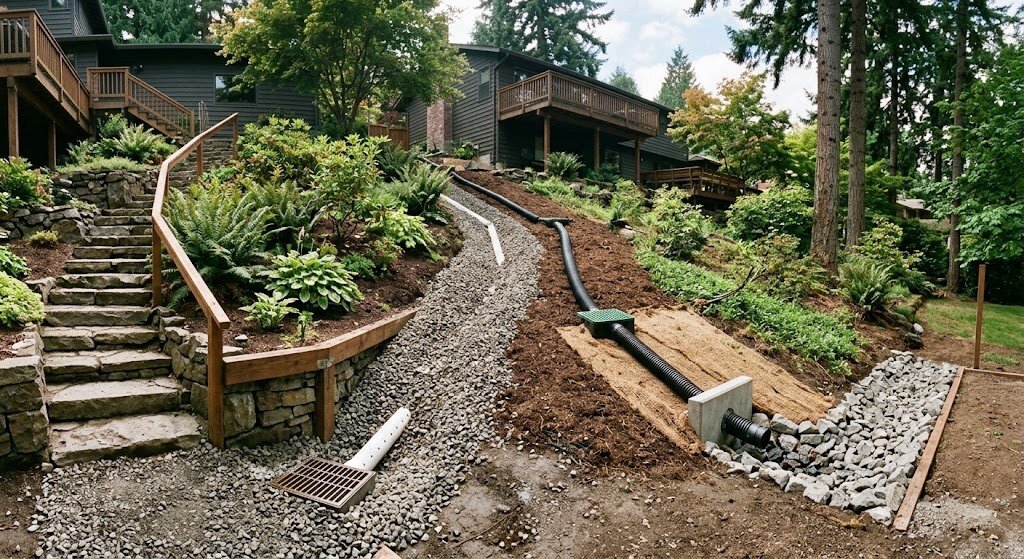
The right drainage system for a steep yard slows water down, spreads it out, and sends it somewhere safe before it reaches your foundation. On a flat lot, rain mostly soaks in where it lands, but on a slope, it picks up speed, carries soil with it, and collects at the bottom, often right against a house, patio, or retaining wall.
That makes steep yards prone to a predictable set of problems: gullies cut into the lawn, mulch washing onto the driveway, soggy low spots, wet basements, and walls that bow under water pressure. The good news is that every one of these has a proven fix. The trick is matching the fix to your slope, your soil, and where the water is actually coming from.
For more than 40 years, TLC Incorporated has helped homeowners across the greater Baltimore area tame water on sloped and hillside yards. Every project starts with a close look at how water actually moves across your property. From there, we design a drainage system built for steep grades, Maryland’s dense clay soil, and the region’s heavy spring and fall rains.
This article will help you choose the right yard drainage system if you have a steep yard.
Start by Evaluating Your Yard
Before you buy pipe or gravel, spend a rainy afternoon outside with an umbrella. Watching where water goes during a real storm tells you more than any diagram. Then check three things.
How steep is the slope? Drive a stake at the top of the slope and another 10 feet downhill. Tie a string between them, level it with a line level, and measure the drop at the lower stake. A 1-foot drop over 10 feet is a 10% grade. Under about 5% is gentle, 5–15% is moderate, and anything over 15% is steep enough that erosion control matters as much as drainage.
What kind of soil do you have? Dig a hole about a foot deep, fill it with water, let it drain, then fill it again and time it. If the water level drops an inch or more per hour, your soil drains well. If it barely moves, you likely have clay, and you'll need to move water off the property rather than count on it soaking in.
Where is the water coming from? Note every source: roof downspouts, a neighbor's yard uphill, a driveway, a street, or groundwater seeping out of the hillside itself. Surface runoff and underground seepage need different solutions, so this is the most important question to answer.
The Top Drainage Options for Slopes
Swales. A swale is a shallow, gently sloped channel lined with grass or plants that guides surface water across or down a hill. Running a swale diagonally across the slope, rather than straight down it, slows water and lets more of it soak in. Swales are inexpensive, low-tech, and blend into the landscape, which makes them a great first line of defense.
French drains. A French drain is a gravel-filled trench with a perforated pipe at the bottom, wrapped in landscape fabric to keep out silt. It collects both surface water and groundwater and carries it away underground. On slopes, a French drain placed across the hill above a house or wall can intercept water before it arrives. A slope helps here, since the pipe needs only about a 1% fall to keep water moving.
Terracing and retaining walls. Terraces break one long slope into a series of flat steps. Each level slows runoff and gives water a chance to soak in. Terraces are a bigger investment, but on very steep grades they solve drainage, erosion, and usability at once. Any retaining wall needs gravel backfill and a drain pipe behind it, or trapped water will eventually push it over.
Dry creek beds. A dry creek bed is a rock-lined channel that looks like a natural streambed. It stays dry most of the year and carries fast-moving water during storms. Large river rock resists washing out far better than grass on steep sections, and the result is attractive enough to be a landscape feature.
Channel drains and catch basins. Where water sheets across a hard surface, such as a driveway at the bottom of a hill, a channel (trench) drain set flush in the pavement catches it. Catch basins collect water at low points and feed it into buried pipe. Both work well for concentrated, high-volume flows.
Downspout management. A single roof can shed hundreds of gallons in a heavy rain. Extending downspouts into buried pipe that empties well downhill, or into a rain garden or dry well, often fixes problems people blame on the slope itself.
How to Pick the Right Drainage System
Most steep yards end up with a combination of systems, but your main problem points to where to start.
|
Your main problem |
Start with |
Relative cost |
Upkeep |
|
Water from roof downspouts |
Buried downspout extensions |
Low |
Clean gutters twice a year |
|
Surface runoff cutting gullies |
Swale or dry creek bed |
Low to moderate |
Reseed or reset rocks after big storms |
|
Wet basement or soggy hillside |
French drain across the slope |
Moderate |
Flush the pipe every few years |
|
Water pooling at a driveway or patio |
Channel drain or catch basin |
Moderate |
Clear grates of leaves |
|
Very steep, unusable slope with erosion |
Terracing with drained walls |
High |
Check walls for bulging |
A few rules apply no matter what you choose:
- Always have a safe outlet. Every system must empty somewhere: a storm drain where allowed, a rain garden, a dry well, or a stable spot well away from structures. Never point water at a neighbor's property; in many places that creates legal liability.
- Work with gravity, not against it. Move water across the slope to slow it, and keep pipe outlets lower than inlets.
- Stabilize the soil. Drainage and erosion control go together. Deep-rooted ground covers, native grasses, mulch, and erosion-control blankets hold soil while your system handles the water.
- Size for the big storms. A system that handles a light shower but overflows in a downpour isn't doing its job. When in doubt, go one size up on pipe and gravel.
- Call before you dig. Dial 811 a few days ahead to have buried utility lines marked. It's free and required in every U.S. state.
When to Call a Professional
Plenty of homeowners can dig a swale, lay a dry creek bed, or bury downspout extensions over a weekend. Some jobs, though, call for expert help. Bring in a landscape contractor, drainage specialist, or civil engineer if:
- You need a retaining wall taller than about 3–4 feet, which many towns require to be engineered and permitted
- Water is already entering your basement or cracking your foundation
- The slope shows signs of instability, such as tilting trees, cracks in the soil, or sliding ground
- You aren't sure where water can legally be discharged
A professional assessment usually costs far less than repairing a failed wall or a flooded basement.
The Bottom Line
Choosing a drainage system for a steep yard comes down to three questions: how steep is it, how well does the soil drain, and where is the water coming from? Answer those, start with the simplest fix that addresses your biggest problem, and add systems as needed. With the right combination, your slope can go from a source of mud and worry to a stable, attractive part of your landscape.
Dealing with runoff on a steep yard? For more than 40 years, TLC Incorporated has helped greater Baltimore homeowners solve slope drainage the right way. We start by tracing where the water goes, then build a system designed for Maryland’s clay soil and heavy seasonal rains. Request a free drainage estimate today.
FAQ’s
How do I stop erosion on a steep slope?
Slow the water down and hold the soil in place. Divert runoff with swales or a dry creek bed, then plant deep-rooted ground covers or native grasses. Use mulch or an erosion-control blanket while plants establish. On very steep grades, terracing breaks the slope into stable steps.
How much does it cost to fix drainage on a steep yard?
Cost depends on the system and the size of the job. Downspout extensions and swales are usually the least expensive, French drains and channel drains fall in the middle, and terracing with retaining walls is the biggest investment. An on-site estimate is the only way to get a firm price.
Can I install a drainage system myself?
Simple projects like downspout extensions, swales, and small dry creek beds are reasonable DIY jobs. Hire a professional for tall retaining walls, foundation water problems, or any slope that shows signs of shifting. Always call 811 before digging so buried utility lines can be marked.
When is the best time to install drainage on a slope?
Late summer and fall are ideal because the ground is workable and new plantings can establish before winter. That said, it's best not to wait if water is already damaging your foundation, walls, or landscape.
