
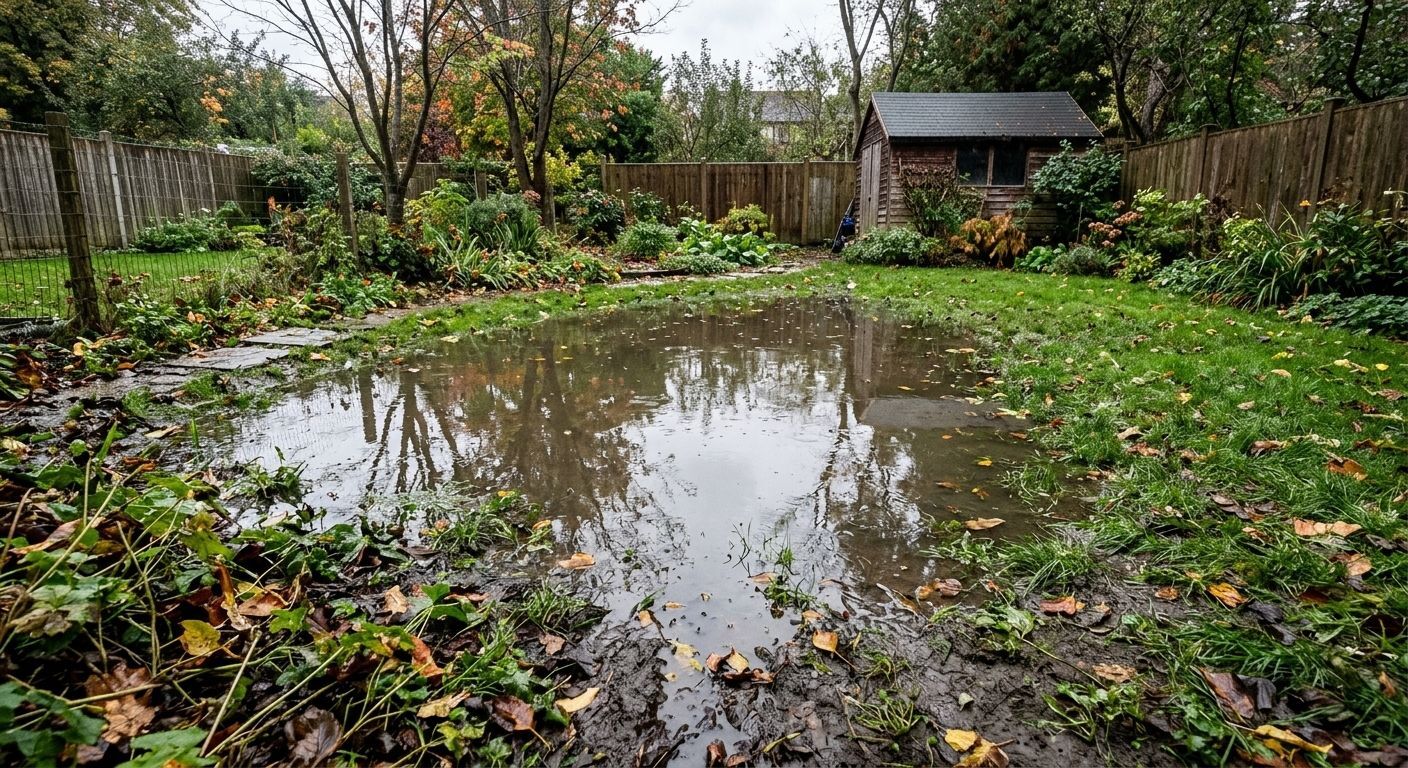
You're standing at your back door after a storm, watching water sit in the same spot it sat last week and the week before that. The puddle hasn't moved. Your grass is turning yellow around the edges, and the soil feels spongy under your shoes.
Before you search for a yard drainage solution, you need to know exactly why that water is pooling. A French drain won't help if the real problem is compacted soil. Regrading won't matter if your downspouts are dumping thousands of gallons against the foundation every month.
TLC Incorporated helps homeowners across Maryland, DC, and Northern Virginia diagnose and resolve standing water problems with customized drainage systems. This guide walks you through seven clear steps to identify the real cause before you commit to any fix.
Quick Guide: How to Find the Cause of Standing Water in 7 Steps (2026)
- Check Your Yard's Grading and Slope. Walk your property after rain to see which direction water flows or stalls.
- Inspect Your Downspouts and Gutters. Confirm that roof runoff moves at least ten feet from the foundation.
- Test Your Soil Type and Compaction. Use a percolation test to measure how fast water soaks into the ground.
- Look for Signs of a High Water Table. Check if puddles return within hours even after dry stretches.
- Trace Runoff from Neighboring Properties. Identify whether uphill lots are sending water your way.
- Map Every Low Spot and Problem Zone. Mark exactly where water collects so the right solution targets the right area.
- Match Each Cause to the Right Drainage Fix. TLC designs each system to address your property's specific water path.
How to Identify the Real Cause of Standing Water Before Choosing a Drainage System
1. Check Your Yard's Grading and Slope
Grading is the number-one reason we see standing water on Maryland properties. When your yard doesn't slope away from the house, rainwater has nowhere to go. It just sits there.
Walk your property during or right after a heavy rain. Watch how water moves. Does it flow away from the foundation, or does it pool against it? According to Fairfax County's Soil and Water Conservation District, the land around your home should maintain a 5% grade for at least ten feet out from the foundation walls.
If you spot areas where water collects instead of draining, you've likely found a grading issue. Low spots near patios, along fence lines, or between houses are common culprits in neighborhoods across Anne Arundel County, Howard County, and Montgomery County.
2. Inspect Your Downspouts and Gutters
Roof water is one of the largest sources of standing water around a home. A typical Maryland home can shed hundreds of gallons during a single storm. If your gutters are clogged, undersized, or your downspouts dump water right at the foundation, you're concentrating all of that volume in the worst possible spot.
Check each downspout during a rainstorm. Is water reaching at least ten feet from the house? If it's pooling within a few feet, a downspout extension or underground tie-in could redirect that water safely away.
We've seen homeowners spend thousands on a French drain when a downspout redirection would have solved 80% of the problem. That's why diagnosing the real source matters before you commit to a system.
3. Test Your Soil Type and Compaction
Maryland's clay-heavy soils are a major factor in standing water problems. Clay absorbs water slowly, holds moisture for days, and compacts easily under foot traffic or construction equipment.
A percolation test from Iowa State University Extension describes a reliable method: dig a hole about 12 inches deep, fill it with water, let it drain, refill, then measure how much the water drops in 15 minutes. Multiply by four for an hourly rate.
If your soil drains less than one inch per hour, you have a genuine infiltration problem. Compacted soil from construction or heavy foot traffic can reduce infiltration by more than 70%, according to research published in the Journal of Soil and Water Conservation.
Knowing whether your soil drains properly changes the entire approach. A surface drain won't help much if the soil itself is the bottleneck.
4. Look for Signs of a High Water Table
Sometimes standing water has nothing to do with grading or gutters. In parts of Maryland, the water table can rise close enough to the surface that your yard stays wet even when it hasn't rained in days.
A high water table usually shows a few telltale patterns. You'll notice water that appears without any recent rain event. The soggy zone stays consistent regardless of season. And if you dig a test hole about 18 inches deep, you may see water seep in from the sides rather than draining downward.
This cause is harder to correct because you can't simply redirect the water. In our experience, properties with a high water table often need a pumped drainage system or a combination of raised beds and strategic grading to keep key areas dry.
5. Trace Runoff from Neighboring Properties
Your yard may be perfectly graded, but if the lot uphill sends water directly onto your property, you'll still end up with puddles. This is especially common in Maryland subdivisions where homes sit close together on varying elevations.
Watch how water enters your yard during a storm. Does it come from the neighbor's driveway, a shared swale, or an open field above? Identifying the entry point helps determine whether a French drain along the property line, a berm, or a channel drain is the right response.
Fairfax County notes that neighbor-to-neighbor drainage disputes are considered a civil matter, meaning the county won't step in to reroute the water for you. That makes catching the problem early and installing the right system even more important.
6. Map Every Low Spot and Problem Zone
Once you've walked the property, you should have a clear picture of where water collects. Grab a simple property sketch or use a photo taken from an upstairs window and mark every spot where water pools after rain.
Note the depth of each puddle, how long it takes to dry out, and whether the puddle grows with each subsequent storm. This information tells a drainage professional exactly what they're dealing with before they set foot on your property.
Mapping also reveals whether you have one isolated issue or a connected chain of problems. A single low spot near the patio may need a catch basin. But multiple soggy zones stretching from the back corner to the foundation wall usually point to a system-level grading or soil issue.
7. Match Each Cause to the Right Drainage Fix
Here's where diagnosis meets action. Each cause you've identified points to a specific type of solution:
- Grading problems: Regrading or swale shaping redirects surface water away from the home.
- Downspout issues: Underground PVC downspout extensions route roof water 20 to 200 feet from the foundation.
- Compacted or clay soil: French drains with perforated pipe in a gravel bed collect subsurface water and carry it to an outlet.
- High water table: A pumped system or sump basin may be necessary where gravity drainage isn't enough.
- Neighbor runoff: A French drain or channel drain along the property line intercepts incoming water before it reaches your lawn.
When you've been solving drainage problems across Maryland for more than 42 years like we have at TLC, you start to see a pattern: homeowners who diagnose before they dig almost always end up with a system that works the first time.
What Are the Warning Signs That Standing Water Is Damaging Your Property?
Standing water does more than kill grass. It creates conditions that slowly compromise the structural integrity of your home. Water that sits against a foundation can seep into basement walls, promote mold growth, and crack concrete over freeze-thaw cycles common in Maryland winters.
Watch for these specific signs that standing water has moved beyond a nuisance:
- Musty smells in the basement or crawl space
- Cracks forming along the foundation wall
- Mulch washing away from garden beds after every rain
- Fence posts softening or leaning at the base
- Mosquito activity concentrated in one area of the yard
Catching these signals early gives you time to address the root cause. TLC's drainage assessment process starts by identifying which of these damage patterns are present and tracing them back to the source.
Can You Fix Standing Water Without Installing a Full Drainage System?
Not every standing water problem requires a full underground drainage system. Some can be resolved with targeted fixes that are faster and less invasive.
If your soil is compacted but not clay-heavy, core aeration followed by top-dressing with compost can improve infiltration over one or two seasons. If the problem is limited to a single downspout dumping water at the foundation, extending that downspout underground may be all you need.
Regrading a small section of lawn to redirect surface flow is another option when the puddle sits in a single low spot. The key is matching the scale of the fix to the scale of the problem. Over-engineering a small issue wastes money. Under-engineering a serious one leads to repeated failures.
How TLC Helps You Solve Standing Water for Good
After more than 42 years working with homeowners across Maryland, DC, and Northern Virginia, TLC Incorporated brings something most contractors can't: local soil knowledge built on thousands of completed drainage projects in the region.
We walk your property, map where water collects, test how your soil responds, and then design a system that addresses every cause we find. That might mean a French drain in one area, a downspout tie-in along the roofline, and regrading near the patio.
Every TLC drainage system comes with a 7-year parts and labor warranty, transparent upfront pricing, and a team that handles everything from trenching to final grade restoration.
If standing water keeps showing up in your yard, don't guess at the fix. Contact TLC for a free, no-obligation consultation. We'll walk your soil, find the real cause, and build the right system the first time.
FAQs About Standing Water in Your Yard
Why does my yard hold water after rain?
Water pools when it can't drain sideways across the surface or soak downward through the soil. Common reasons include poor grading, clay-heavy soil, compacted ground, and downspouts dumping too close to the house. TLC evaluates each of these factors during an on-site assessment to pinpoint the exact cause.
How do I know if I need a French drain or regrading?
If your water problem sits on the surface and disappears within a few hours after rain stops, regrading often corrects it. If water lingers for days or comes from below the surface, a French drain or subsurface system is usually the answer. TLC designs both and recommends the option that matches your property's specific water behavior.
Can standing water damage my home's foundation?
Yes. Water that sits against a foundation wall can seep into the basement, promote mold, and cause cracks over time. Freeze-thaw cycles in Maryland amplify the risk. Redirecting water away from the foundation with proper drainage planning is one of the most effective ways to protect your home long term.
How long does it take to install a yard drainage system?
Most residential drainage projects take between one and three days, depending on the complexity and length of pipe runs. TLC typically completes installations within 7 to 14 days of the initial consultation, and the crew handles all trenching, backfill, and cleanup on site.
Does TLC offer drainage services in my area?
TLC serves homeowners throughout Maryland, Washington DC, and Northern Virginia, including Anne Arundel County, Howard County, Montgomery County, Prince George's County, Frederick County, Baltimore County, and surrounding areas. Contact our Gambrills office at 410-721-2342 to schedule a consultation.
