
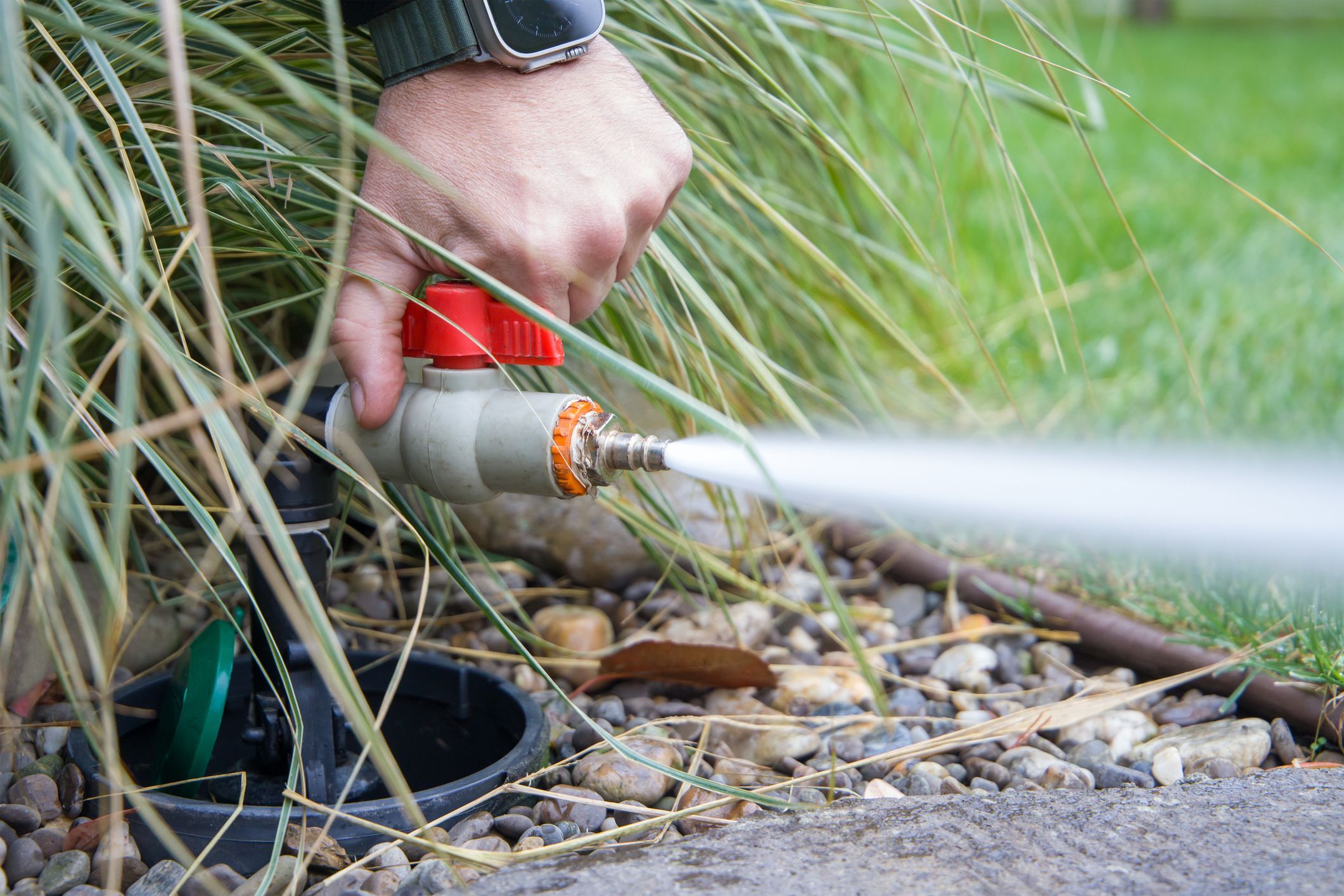
If you've ever looked at a sprinkler quote and seen a mix of "rotors" and "sprays" and wondered what the difference was, this article is for you.
TLC Incorporated designs, installs, and services underground lawn sprinkler systems across Maryland, from 3-zone front-yard systems to full-property installs with 8 or more zones. Every system is zoned for your actual lawn: sun, shade, slope, and beds, plus includes a smart Wi-Fi controller, a wireless rain sensor, and a 7-year written warranty.
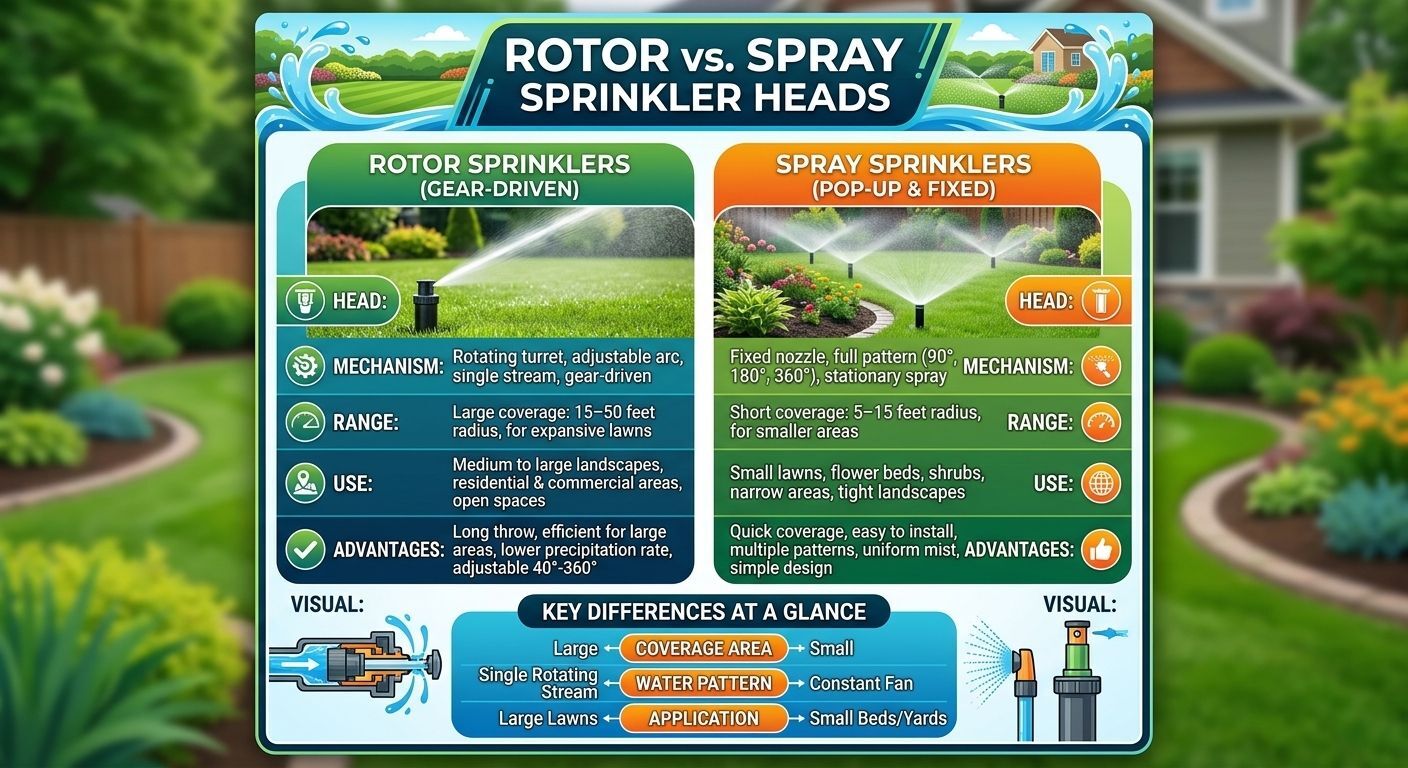
The two head types do the same job in very different ways, and a well-designed system almost always uses both. Understanding why matters, because the most common cause of a lawn that looks patchy despite an expensive irrigation system is these two head types being mixed the wrong way.
The Short Answer
Spray heads pop up and throw a fixed, fan-shaped sheet of water over a small area, all at once. Think of a shower head pointed sideways. They typically cover 4 to 15 feet and put water down fast.
Rotors pop up and shoot one or more streams of water that rotate slowly back and forth across a large area. Think of a hose turned to the jet setting, sweeping across the yard. They usually cover 18 to 55 feet and put water down slowly.
Sprays cover small spaces quickly. Rotors cover big spaces slowly. That difference drives everything else.
How Rotor and Spray Heads Actually Differ
Coverage area
This is the main one. A spray head covering a 12-foot radius handles a strip along a walkway or a narrow side yard. A rotor covering 35 feet handles an open back lawn with a fraction of the number of heads.
On a large open lawn, using sprays instead of rotors would mean installing three or four times as many heads, plus the trenching and fittings that go with them. That's why rotors exist.
Precipitation rate
This is the number that trips people up, and it's the reason the two can't be mixed casually.
Precipitation rate is how fast a head applies water, measured in inches per hour. Spray heads typically apply water at roughly 1.5 to 2 inches per hour. Rotors typically apply at about 0.4 to 0.6 inches per hour.
That's a difference of three or four times. A spray head delivers as much water in 10 minutes as a rotor does in 35.
Run time
Because of that, sprays and rotors need completely different run times. A spray zone might run 10 to 15 minutes. A rotor zone covering the same conditions might need 35 to 45 minutes to deliver an equivalent amount of water.
Water pressure and flow
Rotors generally need more pressure to throw water that far, often in the 35 to 65 psi range, while sprays work at lower pressure, often 25 to 30 psi. Rotors also use more water per head, though fewer heads are needed.
If your water pressure is marginal, rotors are the first thing that suffers. Streams fall short, the far edge of the lawn goes dry, and no amount of extra run time fixes it, because the water simply isn't reaching.
Droplet size and wind
Rotors throw larger droplets in a concentrated stream, which resists wind reasonably well. Spray heads produce a fine mist that drifts, which is why spray zones lose more water to evaporation and wind on a breezy Maryland afternoon, and part of why early-morning watering is standard advice.
Cost
Rotors cost more per head than sprays, but you need far fewer of them. On a large lawn, rotors come out cheaper overall once you count the heads, fittings, pipe and labor. On a small or oddly shaped lawn, sprays win.
The Rule That Matters Most: Never Mix Them on One Zone
If you take one thing from this article, take this.
Spray heads and rotors must never share a zone. Because they apply water three to four times faster or slower than each other, any run time you choose will be wrong for half the heads. Run the zone long enough for the rotors and the spray areas get drowned, with runoff, fungus and soggy spots. Run it short enough for the sprays and the rotor areas stay brown.
This is the single most common design mistake we find on systems installed by other companies, and it's one of the most common causes of "my lawn has dry patches no matter how long I water."
The fix is proper zoning: sprays on their own zones, rotors on their own zones, each with a run time that fits.
Related is matched precipitation within a zone. Even among rotors alone, a full-circle head covers twice the area of a half-circle head, so it needs to put out twice the water to apply the same depth. Quality heads use matched precipitation rate nozzles to handle this. Without them, corners and edges get overwatered while the middle stays dry.
Which One Does Your Yard Need?
Most Maryland properties need both, in different places.
Rotors make sense for:
- Open front and back lawns wider than about 18 to 20 feet
- Large turf areas where fewer heads mean less trenching
- Full-sun lawn that needs deep, even watering
- Sloped areas, since the slower application rate gives water time to soak in rather than run off, which matters a lot in our clay soil
Sprays make sense for:
- Narrow strips along driveways, walkways and side yards
- Small townhome lots and front-yard-only systems
- Curved beds and irregular shapes where you need precise edges
- Areas close to the house, patios and hardscape where overspray is a problem
- Tight spaces where a rotor would water your siding
A typical medium home in Maryland ends up with rotor zones covering the open front and back lawn and spray zones handling the strip by the driveway, the side yard and the beds near the house.
What This Means When You're Comparing Quotes
A few things worth checking when you have two irrigation quotes side by side:
Are sprays and rotors on separate zones? If a quote shows fewer zones than a competitor's for the same yard, this is often why, and it's a real problem rather than a savings.
Are the heads spaced head-to-head? Both types are designed so each head's spray reaches the next head. Stretched spacing is the cheapest way to shave a quote, and it produces exactly the dry patches people call us about in July.
What's the nozzle quality? Matched precipitation rate nozzles cost a little more and are the difference between even coverage and a lawn with wet corners.
Does the design account for your water pressure? A design full of long-throw rotors is worthless if your pressure can't push them.
The Bottom Line
Rotors and sprays aren't competitors. They're different tools for different parts of the same yard, and the skill in irrigation design lies in knowing where each belongs and keeping them on separate zones with run times that match.
TLC Incorporated has been designing, installing, and maintaining underground lawn sprinkler systems for Maryland homeowners for over 40 years.
If your lawn has persistent dry spots, soggy corners, or areas that never seem to green up no matter what you set the controller to, the problem usually isn't your controller. It's how the heads were chosen and zoned in the first place. TLC Incorporated offers free lawn sprinkler system evaluations, just click the button below to get started.

Frequently Asked Questions
Can I mix rotors and spray heads on the same zone?
No. They apply water at very different rates, so any run time will be wrong for one type or the other. This is the most common design mistake in residential irrigation, and it shows up as a lawn with both soggy patches and dry ones.
What about rotary nozzles?
The advantage of rotary nozzles is a low precipitation rate, around 0.4 inches per hour, which suits clay soil and slopes because water has time to absorb instead of running off. They're also less prone to misting in the wind. The tradeoff is longer run times, and like anything else, they can't be mixed on a zone with standard sprays.
How long should I run each type?
It depends on your soil, slope, sun, and season, but as a rough guide, spray zones run in the 10 to 15 minute range and rotor zones run roughly three times longer for the same amount of water. Your installer should set starting times based on your specific property.
Which one uses more water?
Per head, rotors use more. Per square foot of lawn, they're comparable, and rotors are often more efficient on large areas because they lose less water to misting and drift.
Which costs more?
Rotors cost more individually, but you need far fewer of them on a big lawn, so they usually cost less overall there. On small or complex lawns, sprays are more economical.
Why does my sprinkler system have both?
Because your yard has both kinds of space. Open lawn is best served by rotors, while narrow strips, curves and areas near the house need the precision of sprays.
Which is better for a sloped yard?
Rotors or rotary nozzles, because their slower application rate gives water time to soak in rather than run downhill. That matters especially in Maryland's clay soil, which absorbs water slowly.
My lawn has dry patches. Is it the head type?
Often it's related. The usual suspects are mixed head types on one zone, stretched head spacing, mismatched nozzles, or pressure problems. A coverage audit will identify which, and it's a much cheaper fix than replacing a system.
